Hardware
Options for SDR hardware and host computers
For a general overview of the ORCA system, we highly recommend reading through our publication:
T. O. Teisberg, A. L. Broome and D. M. Schroeder, “Open Radar Code Architecture (ORCA): A Platform for Software-Defined Coherent Chirped Radar Systems,” in IEEE Transactions on Geoscience and Remote Sensing, vol. 62, pp. 1-11, 2024, Art no. 5109411, doi: 10.1109/TGRS.2024.3446368.
Code for ORCA can be found on the Github Page, which contains additional details about downloading and testing ORCA on the radios that are currently available.
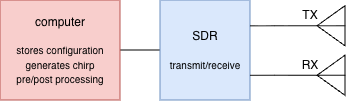
This guide is divided into three parts to help set up and understand ORCA. ORCA uses a computer and a software-defined radio (SDR) to create a functioning radar. As the architecture is currently configured, the computer is a Raspberry Pi, and the SDR is an Ettus radio. Current work is being done to implement ORCA on a Xilinx board, which would act as both a computer and SDR. Below is a simplistic block diagram that details the interaction between the hardware pieces that ORCA is intended to be used for.
Setup Guide for Beginners contains more introductory information concerning essential hardware and software ideas and information.
Options for SDR hardware and host computers
Overview on how to set up ORCA and SDR. If you are new to ORCA or SDRs, start here.
Overview of SDR-interfacing code
How to set up the Raspberry Pi to generate a chirp, communicate with the SDR, and perform pre- and post-processing
Working with data recorded using ORCA